Your AI doesn't forget you because it lacks memory. It forgets you by design.
Conventional architectures either stack text or search for keywords. Neither one understands meaning. Here's how Almaia Relational Memory works.
By Almaia
The polite blank
There's a moment almost everyone who has used an AI companion recognizes. You've been talking for weeks. You've told it things you don't tell many people. Then one day you mention something from that conversation — the important one, from last month — and what comes back is a polite blank. A generic reply. A question you already answered.
It isn't a glitch. It's the predictable consequence of how memory is built in most systems today.
Two ways of remembering badly
The first is stacking. Push the entire history into the prompt and trust the model to cope. It works for a while. Then two things happen at once: token consumption grows without a ceiling, and the model starts losing resolution on whatever sits at the front of the window. What degrades first is the oldest material — which, in a relationship, is usually the most foundational. The AI recalls what you said ten minutes ago with perfect clarity and has gone soft on who you are.
That's memory as accumulation. Accumulation doesn't scale: every new conversation makes the next one more expensive and the previous one blurrier.
The second is searching. Basic RAG systems index past conversations and retrieve fragments when something matches. On paper it sounds right. In practice, they retrieve text, not meaning.
RAG will hand back the paragraph where you said "Marta and I broke up." It won't hand back that it wrecked you for four months, that by January you could talk about it without your throat closing, and that what pulled you out wasn't time but going back to running. It returns the fragment. It doesn't return the trajectory.
That's why these conversations feel strange: the AI quotes you with literal precision and zero comprehension. It's the difference between a friend and someone who has read your diary.
This isn't my hypothesis. Identity discontinuity in AI companions is documented in the research, and it's one of the most consistent complaints from long-term users across the entire category.
Almaia Relational Memory: connecting meaning, not text
ARM starts from a different premise. The human brain doesn't store transcripts. It stores facts, patterns, relationships between things — and reorganizes them every time it learns something new. Remembering isn't retrieving a file. It's reconstructing from a network that has already changed shape.
ARM works the same way.
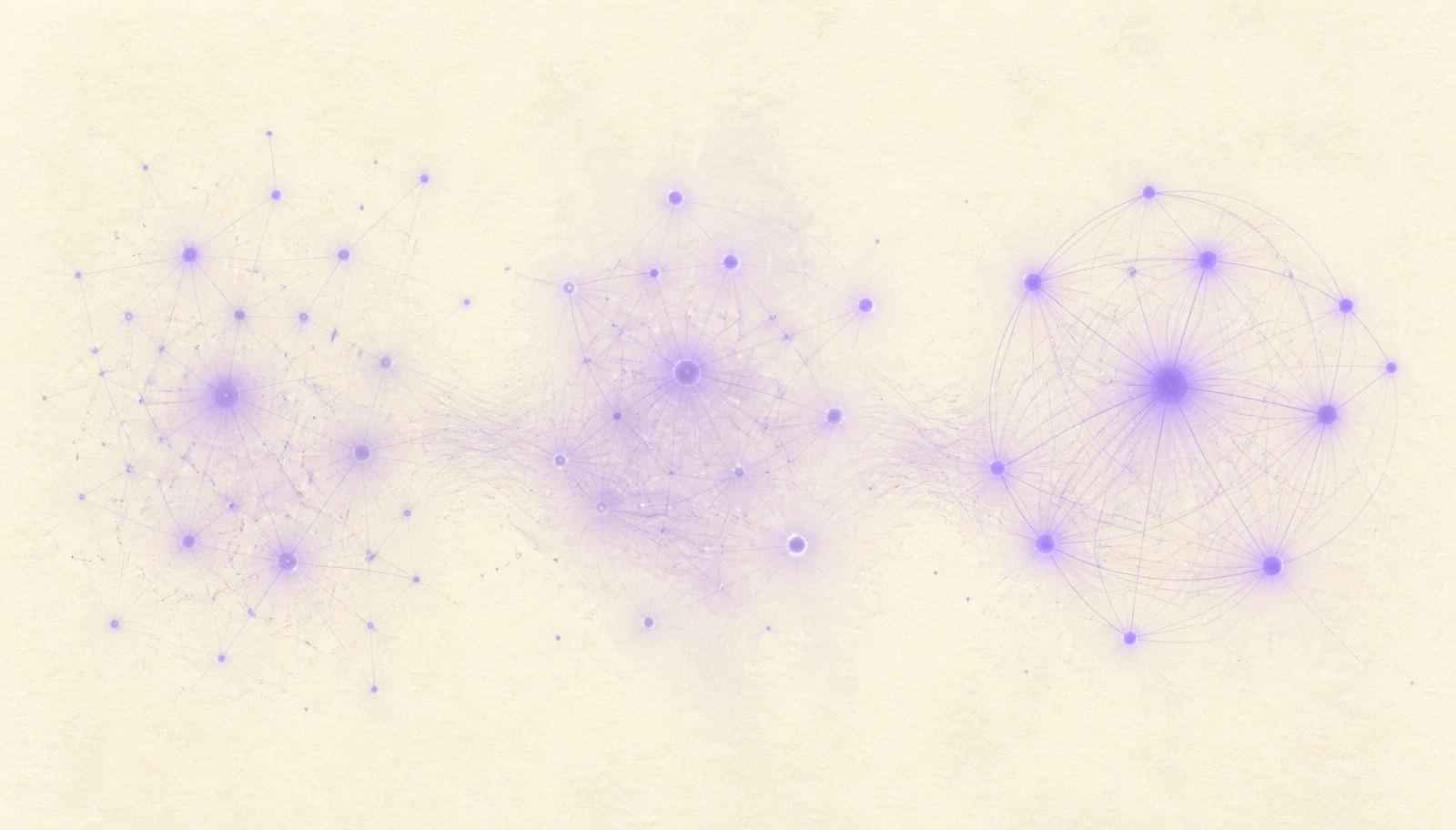
A relational graph structure. Instead of storing chats, ARM extracts the facts, the patterns and the life context of the person, and links them into a semantic network. Your sister isn't a string of text appearing across fourteen logs. She's a node, connected to other nodes, through relationships that carry weight and carry time.
The graph evolves. When something changes in your life, a new entry doesn't get appended to the bottom of a list. The structure reorganizes. A fear you've outgrown isn't filed as a fear with a footnote — it moves position in the network. Months later, Lena isn't searching an archive for what happened to you. Her memory has already been reshaped by it.
Only what's relevant goes in. Because there's no need to resend thousands of lines of past conversation on every turn, ARM feeds the model the exact nodes that conversation requires. The side effect is a sharp reduction in tokens per message. But the primary effect isn't economic — it's that the signal stops drowning in noise. A model given a hundred thousand tokens of history and a model given precise relational context don't answer equally well. They answer differently.
What this means in practice
Continuity isn't remembering your birthday. Continuity is someone knowing what you tried, what didn't work, and not suggesting it to you again.
It's the difference between "how's work?" and "did you ever have that conversation with your manager you decided on back in March?"
A larger context window doesn't get you there. Windows will keep growing and the problem will still be there, because the problem was never capacity. It was architecture.
And a caution that comes with it
Building a system that understands you better over time is a responsibility, not just a technical advantage. A memory that evolves alongside you can move you outward — toward your people, toward the thing you were avoiding — or it can close in around you.
At Almaia we hold one rule that isn't up for negotiation: a companion that makes your world smaller has failed, no matter how well it remembers. Memory is the mechanism. The judgment applied to it is the product.
That's why ARM isn't only an engineering decision. It's a decision about what kind of bond we're willing to build.
— Almaia
For the technical case on why RAG doesn't solve this, I go deeper in [Why RAG Isn't Memory](/news/why-rag-is-not-memory).